
Birds
Sea Eagle / Golden Eagle
The Sea Eagle is bigger by a third than the Golden Eagle, they have very broad square ended wings and a wedge-shaped tail which is white in adult birds. They feed on a diet of seabirds and fish, catching fish by plunging their powerful talons into the water. The Golden Eagle has a smaller head and a longer tail than the Sea Eagle, they are dark in colour with the adults showing a paler area on their head. They like to soar and glide on air currents and are most often sighted soaring high over cliffs or hillsides.

© – Arthur Campbell, Arisaig
Puffin
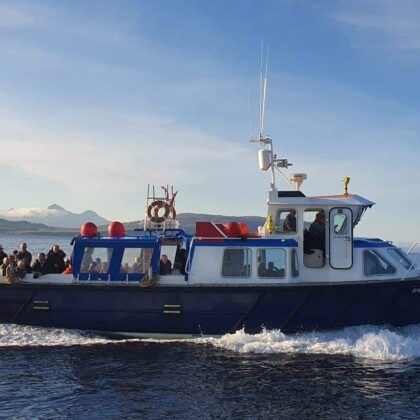
Puffins can easily be recognised by their colourful bill and orange feet contrasting with their black and white body and wings. They dive and catch fish underwater and are particularly fond of sand eels. Puffins are very popular visitors to the area and can be spotted on the water whilst sailing to the islands on MV Sheerwater.

©- Arthur Campbell, Arisaig
Gannet
Adult Gannets are large and bright white with black wingtips. They are distinctively shaped – with a long neck and long pointed beak, long pointed tail, and long pointed wings. At sea they flap and then glide low over the water, often travelling in small groups. They feed by flying high and circling before plunging into the sea. Gannets breed in significant numbers in only a few locations and are an Amber List species.

© – Arthur Campbell, Arisaig
Sandwich Tern
The Sandwich Tern is very slim with a long neck, they are white with a black cap on the top of their head, and a long yellow tipped black bill. They feed on fish such as sand eels, sprats and whiting and can be seen from late March to September. Sandwich Terns are rare, and we only usually have a couple of sightings each year.
Great Skua / Pomarine Skua
The Great Skua is the largest and heaviest of the skuas and is dark and almost gull like with light flashes on its wings, it is an aggressive and agile bird that chases and harasses other birds in order to steal their food. They commonly kill and eat smaller birds such as puffins. They breed in Northern Scotland and will dive bomb anybody that gets too close to their nests. The Pomarine Skua is larger than the Arctic Skua and nearly as big as a Herring Gull. There are two colourings, dark and light. The dark are all dark brown with flashes of white on the wings while the light variety are brown with pale breast and dark brown cap on their heads. Passage migrants, they do not breed in the UK and can be seen between late April and May, and between August and November.

© – Arthur Campbell, Arisaig
Storm Petrel
Storm Petrels are small black, white rumped birds, slightly bigger than a sparrow and, unlike the Leach’s Petrel, they have a square tail. They often feed in flocks at sea and follow in the wake of ships, especially trawlers. They flutter over the sea often with their feet dangling close to the surface. They breed on isolated coasts of Western Britain and France and winter at sea.
Leach’s Petrel
Similar in size to a starling, the Leach’s Petrel is mostly black apart from its white rump which has a black line down it. It has a longer wingspan than the Storm Petrel and a forked tail. Unlike the Storm Petrel, it does not generally follow ships. It breeds on remote offshore islands in north and west Scotland and migrates to the tropics in the winter, although a few remain in the North Atlantic.